
The global pharmaceutical and chemical industries are expanding rapidly, driven by healthcare demand, biotech innovation, and industrial growth. This expansion is generating increasingly complex pharmaceutical waste and chemical waste streams that conventional treatment systems struggle to handle effectively.
Key environmental risks include:
Persistent toxicity at trace levels
High chemical stability and poor biodegradability
Potential dioxin/furan formation under improper thermal treatment
Secondary pollution risks to air, water, and soil
Traditional incineration often fails to ensure stable, complete molecular destruction under variable operating conditions, making compliance with modern environmental standards more challenging.
To meet these requirements, next-generation advanced thermal treatment technologies are needed—designed for controlled, high-efficiency molecular decomposition rather than simple combustion.
At high temperatures, incomplete combustion can generate: Dioxins, Furans, NOx and SOx compounds
Variations in waste composition can lead to: Temperature fluctuations, Incomplete oxidation, Inconsistent emission performance
Maintaining high-temperature combustion requires significant auxiliary fuel input, reducing system efficiency.
Incineration focuses on burning, not controlled molecular decomposition.
MagnetGas is an advanced hazardous waste treatment technology developed by EASE Environmental Solutions.
It is specifically engineered for:
Unlike conventional incineration systems, MagnetGas is based on a controlled gasification–pyrolysis–catalytic oxidation architecture, designed to achieve deep molecular breakdown of complex waste streams under tightly controlled conditions.

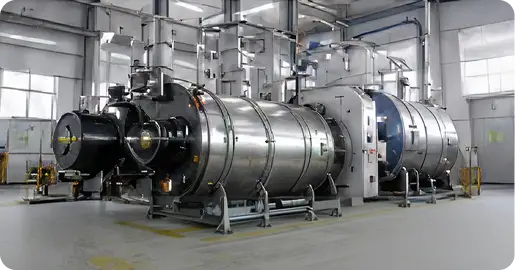
The system is engineered to minimize: Dioxins and furans, NOx emissions, Acid gases, Particulate matter It is designed for compliance with strict environmental frameworks including EU BAT standards and North American regulations.
MagnetGas can handle a wide range of waste types: Pharmaceutical residues, Chemical solvents, Laboratory waste, Mixed hazardous waste streams This flexibility reduces the need for pre-sorting or complex preprocessing.
The RCO system integrates heat regeneration, improving overall system efficiency and reducing external energy demand.
The system uses advanced automation for: Temperature regulation, Oxygen ratio control, Pressure balancing, Real-time emission monitoring This ensures stable operation even under variable waste conditions.
The skid-mounted structure allows: Fast installation, Reduced infrastructure requirements, Easy system expansion, Flexible deployment in different industrial environments
No. MagnetGas is a controlled thermal conversion system based on gasification and catalytic oxidation, not combustion-based incineration.
Yes. The system is designed to process pharmaceutical residues, APIs, and contaminated organic materials.
Yes. It is designed for compliance with EU BAT and North American emission requirements.
